We had the opportunity to talk with him about his career path, goals, horses, and what motivates him day by day in the sport, as well as the mindset behind building his career. In this interview, you can get a closer look at one of the key figures of Italian show jumping, who was also a member of the winning team at last year’s CSIO Budapest Nations Cup.
Kitti: When did you start riding, and how did your passion for horses begin?
Giacomo:
Well, I started riding at a stable close to our home because my father really loved this sport. He was an amateur rider, mostly competing in 120–130 cm classes, so through him I basically got introduced to the world of horses.
What’s interesting is that before that, I tried many other sports. I come from a completely average family, and everyone knows that riding is quite an expensive sport. The truth is, however, that I was terrible at all the other sports, so in the end I stuck with riding.
My parents made huge sacrifices so that I could follow my passion, and I am incredibly grateful to them to this day.
K: You mentioned that you built your career completely from scratch. What is the most important advice you would give to the younger generation who would like to follow a similar path?
G:
Yes, I truly built my career from the ground up. However, one very important thought has always been in my mind: the key to development often lies precisely in the tasks we would most like to avoid. Many times there are exercises or types of work we don’t enjoy doing – maybe because we are tired, or because we find them difficult, or they simply don’t suit us. But real progress begins exactly when we face these challenges and work through them. Growth often lies in the very things we would otherwise choose to skip.
K: If you could send a message to your younger self, what would you say?
G:
I would tell my younger self not to stress so much about results. Don’t let the pressure or frustration of performance take away the joy of what you do. It is much more important to learn to love the journey than to chase the goal – to enjoy the process of development.
Always remember that the windshield is much bigger than the rearview mirror. The reason is simple: what lies ahead of us is far more important than what we leave behind. You have to look forward, and then everything will fall into place.
K: Which horse has had the biggest impact on your career so far, and why? What type of horses do you prefer to ride the most?
G:
The horse that clearly changed my career path was Cape Cod. A homebred horse – in fact, my mother rode him before I did. With him, I was able to take a major step forward in the sport, as when he started jumping in the biggest classes, I also made it into the Italian national team.
As a rider, it was also then that people noticed that I work particularly well with more temperamental, sensitive horses – those that have a smaller stride, are more cautious, and require finer riding. He was exactly like that. Since then, owners and breeders I work with deliberately trust me with this type of horse.
Cape Cod therefore left a deep mark on my career, and he was the horse that truly raised me to a higher level in the sport.
K: In your opinion, what are the three most important qualities that define a truly exceptional horse?
G:
For a horse to reach the highest level, it needs three fundamental qualities. First, it must be brave, second, very careful over jumps, and perhaps most importantly: highly intelligent.
Truly intelligent horses, however, require particularly sensitive riders. The rider must understand what the horse is “thinking”, and sometimes needs to step outside traditional training methods in order to build a real connection.
It’s like when you’re talking to someone in a bar whose language you don’t speak – yet you still feel what they think and feel. In such cases, communication doesn’t happen through words, but through body language. The same applies to riding: the rider must communicate with their own body and create a relationship in which the horse is willing to cooperate.
K: You are also known for riding more difficult, sensitive horses – such as Cash du Pratel – exceptionally well. What is your greatest strength as a rider, and what advice would you give to riders working with challenging horses?
G:
Cape Cod played a major role in this – he shaped me into this kind of rider. I have always been a sensitive type, and I can easily feel the horse’s emotions – it almost flows through them, something I can sense through my own body as well. This helps me a lot with horses that are more nervous, stressed, or highly temperamental, like Cash and similar types.
The real difficulty lies in the fact that you have to learn to interpret these feelings. From the horse’s side, tension or uncertainty often appears, as ultimately we are asking them to do something they were not born to do. In these moments, the rider’s job is to stand by the horse and communicate in the best possible way – even if we don’t speak the same “language.”
I consider myself more of a psychologist for my horses rather than just a rider in the technical sense. This approach works especially well with more sensitive, emotionally responsive horses.
K: Which of your results are you most proud of so far, and what goals would you still like to achieve in the sport?
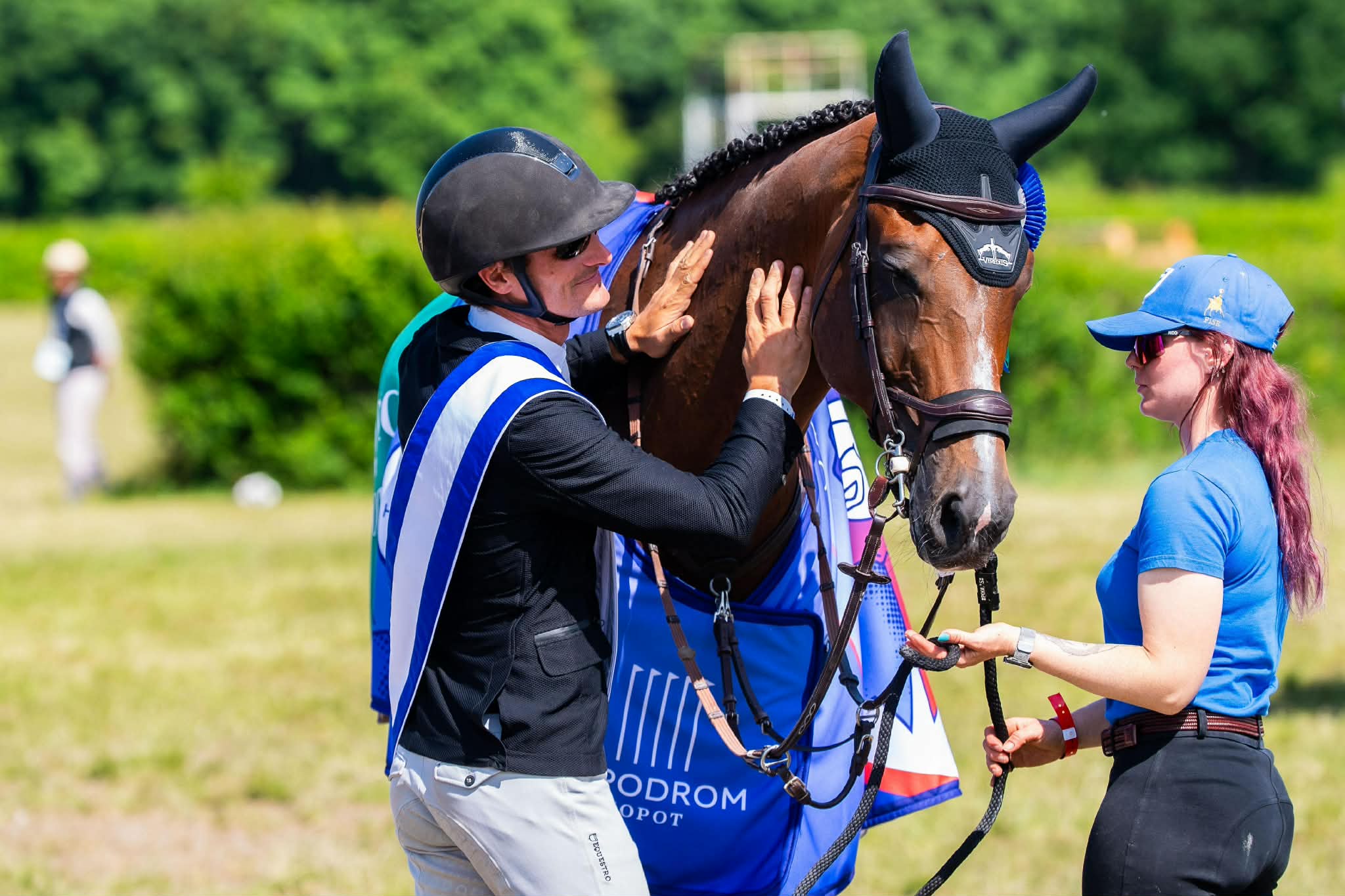
I am very proud of the journey I have taken so far, even if I don’t consider the point I’m at now to be the end of the story. I want to keep improving continuously, to keep learning, because there is still a lot I can improve on.
Of course, I would like to compete in the biggest international series, not just three or four times a year. My goal is to be consistently present at the highest level – especially considering that I built all of this from scratch, starting from an average financial background.
One of my biggest dreams is, of course, the Olympics. But just as important to me is the journey itself: working with horses, building my own stable, growing my business, and strengthening my name in the sport. For me, it is already a great joy to be part of this world.
K: If you could choose any horse from history, which one would you like to ride, and in which competition would you compete with it?
I think that, based on my style and character, a horse like Jappeloup would suit me very well. He was a smaller horse, but extremely temperamental and very sensitive – exactly the type I truly enjoy working with.
I feel he would be a perfect partner for me. It would be an incredible experience to ride him, and of course, the real dream would be to compete with him at the Olympics or at the World Cup. That would truly be a dream come true for me.
We would like to thank Giacomo for sharing these great thoughts on behalf of Hungarian riders, and we hope many will find useful inspiration in his words. We also hope to welcome him back to Hungary many times with his fantastic horses.
Grazie mille!