A horse’s musculature does not simply “grow” from training. Training is, in fact, a catabolic process: micro-damage occurs in the muscle fibers, energy stores are depleted, and the neuromuscular connection is under continuous strain. Muscle development always takes place after the workload, and only if the body has access to all the necessary building blocks. Muscle Fusion intervenes precisely at this critical stage, which is why it cannot be considered a simple protein supplement or “muscle-building feed.”
How does muscle build in the horse?
The basic building blocks of muscles are proteins, and proteins are made up of amino acids. A horse’s body uses a total of twenty different amino acids during protein synthesis, but it can only produce some of them on its own. The so-called essential amino acids must be obtained exclusively from feed. If even a single essential amino acid is missing or underrepresented, the entire muscle-building process slows down or comes to a halt. This is known as the “limiting amino acid” phenomenon, which explains why, in many cases, muscle development remains disappointing despite appropriate training.
One of the greatest strengths of Muscle Fusion lies precisely here: it is not built around one single highlighted amino acid, but provides a broad spectrum of essential amino acids required for muscle protein synthesis. This is crucial because the regeneration and strengthening of muscle fibers do not occur through a single pathway. Some amino acids are involved in building contractile proteins, others in stabilizing the connective tissue between muscle cells, and still others in repairing micro-damage caused by training. A broad amino acid profile allows these processes to take place simultaneously, reinforcing each other.
How can functional muscle be built?
The presence of essential amino acids influences not only muscle mass, but also muscle quality. A muscle that is well supplied with amino acids is denser, more elastic, and able to utilize energy more efficiently. In practice, this means better stamina, delayed fatigue, and faster recovery. In this sense, Muscle Fusion does not build “show muscles,” but functional musculature that can withstand workload and return to work again and again without overloading tendons and joints.
It is also important to understand that muscle and the nervous system are closely interconnected. If muscles do not receive the proper building blocks, neuromuscular signal transmission deteriorates, movement becomes less coordinated, the horse tires more quickly, and the risk of injury increases. By providing a complete amino acid profile, Muscle Fusion indirectly reduces strain on the nervous system as well, since the muscles work more efficiently and less “compensatory tension” develops.
Why is Muscle Fusion so effective during the conditioning phase?
This is particularly important for young horses whose musculature is still developing, as well as for sport horses preparing for or undergoing intensive training or competition periods. At such times, muscle breakdown and rebuilding occur almost continuously, and deficiencies can quickly appear in the form of loss of condition, muscle fatigue, or fluctuating performance. Regular use of Muscle Fusion helps stabilize this balance and ensures that training truly has a building effect rather than being excessively catabolic.
For this reason, the product is not ideally used only occasionally, but rather as a course (daily use for a defined period) or continuously during the competition season. It is especially effective when fed after training, when muscle nutrient uptake is increased and protein synthesis naturally accelerates. During this window, the presence of essential amino acids quite literally determines the quality and speed at which muscle is rebuilt.
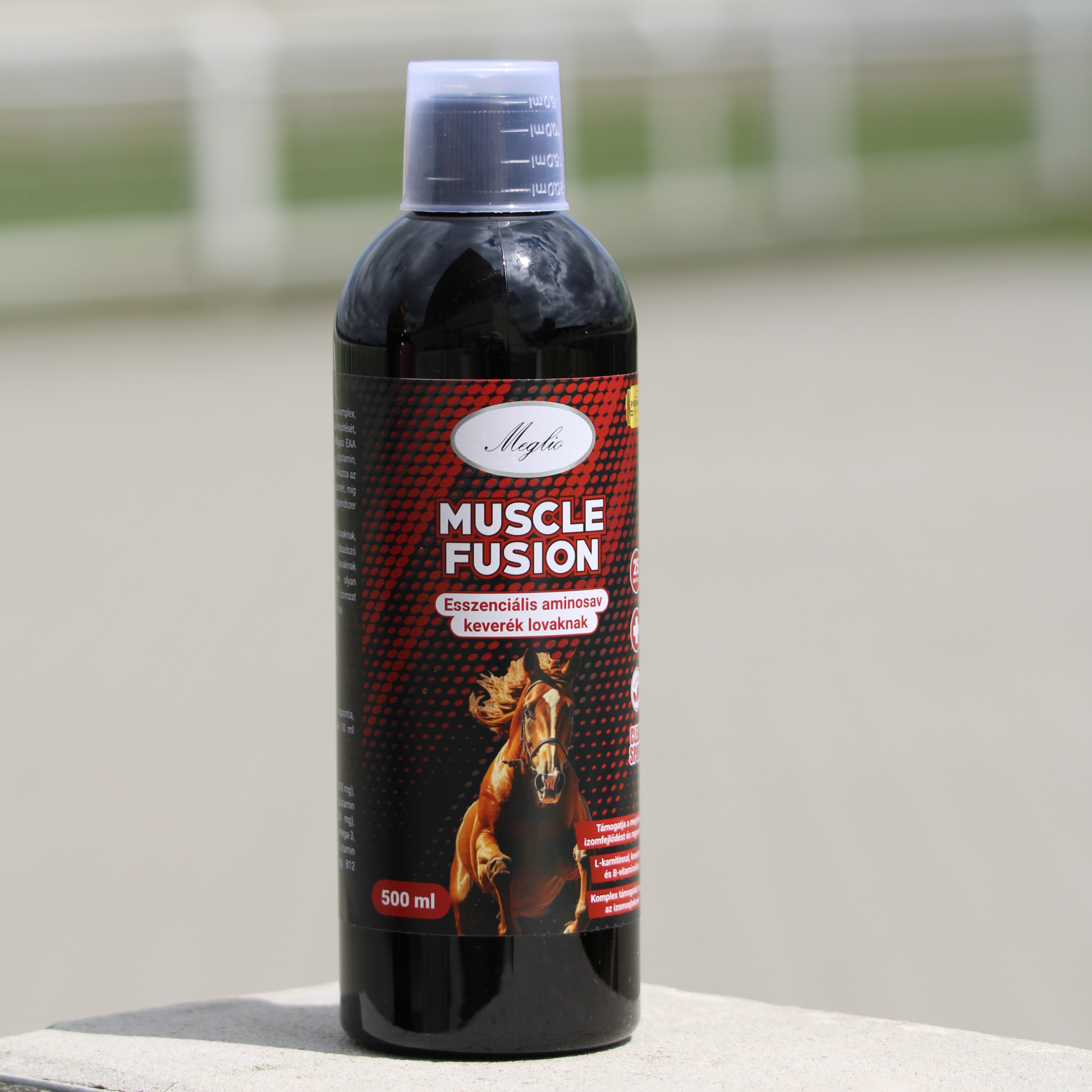
In summary, Muscle Fusion is not a “quick fix,” but a consciously designed muscle-support system. By providing several essential components among the twenty amino acids in appropriate proportions, it allows the horse to respond to training with true adaptation. The result is not only stronger and more aesthetic musculature, but better quality of movement, greater endurance, and, in the long term, a healthier sporting career.